Tampa Bay closed the regular season with a win and a clear identity as late results reshaped the USL Championship playoff field.

The USL Championship’s final regular-season slate turned playoff positioning into a last-minute story. Tampa Bay beat Jacksonville 2-0 to close its campaign, while the West’s top seed changed hands and the East’s final postseason place was decided. Phoenix also took the West’s eighth spot from Oakland in a 20-minute swing around midnight. The results left little room for teams to manage the final day as a formality: even clubs already in the postseason picture had reason to watch how the standings shifted around them.
The top four seeds in each conference held onto home-field advantage for the opening round, but the remaining places shifted across the board. That split captures the tension of the finale: some teams protected a meaningful advantage, while others were still fighting simply to qualify. Tampa Bay’s Week 34 performance offered a steadier kind of drama: a team with a new roster showing the same clear identity it had carried since opening day. That continuity is more significant than it looks, because a late-season lineup change can expose how much a team depends on familiar combinations.
Tampa Bay finishes with its principles intact
Trending: +1
Result: 2-0 win vs. Jacksonville
The Rowdies made nine lineup changes against Sporting Jacksonville and still played on the front foot. That consistency has been a defining feature of their season, and it held up even as the regular-season finale gave the coach’s choices a different look. A rotated lineup can disrupt pressing cues and distances between teammates; Tampa Bay’s approach remained recognizable despite the personnel changes. The result suggests the team’s identity is carried by its structure as well as by the players who usually start.
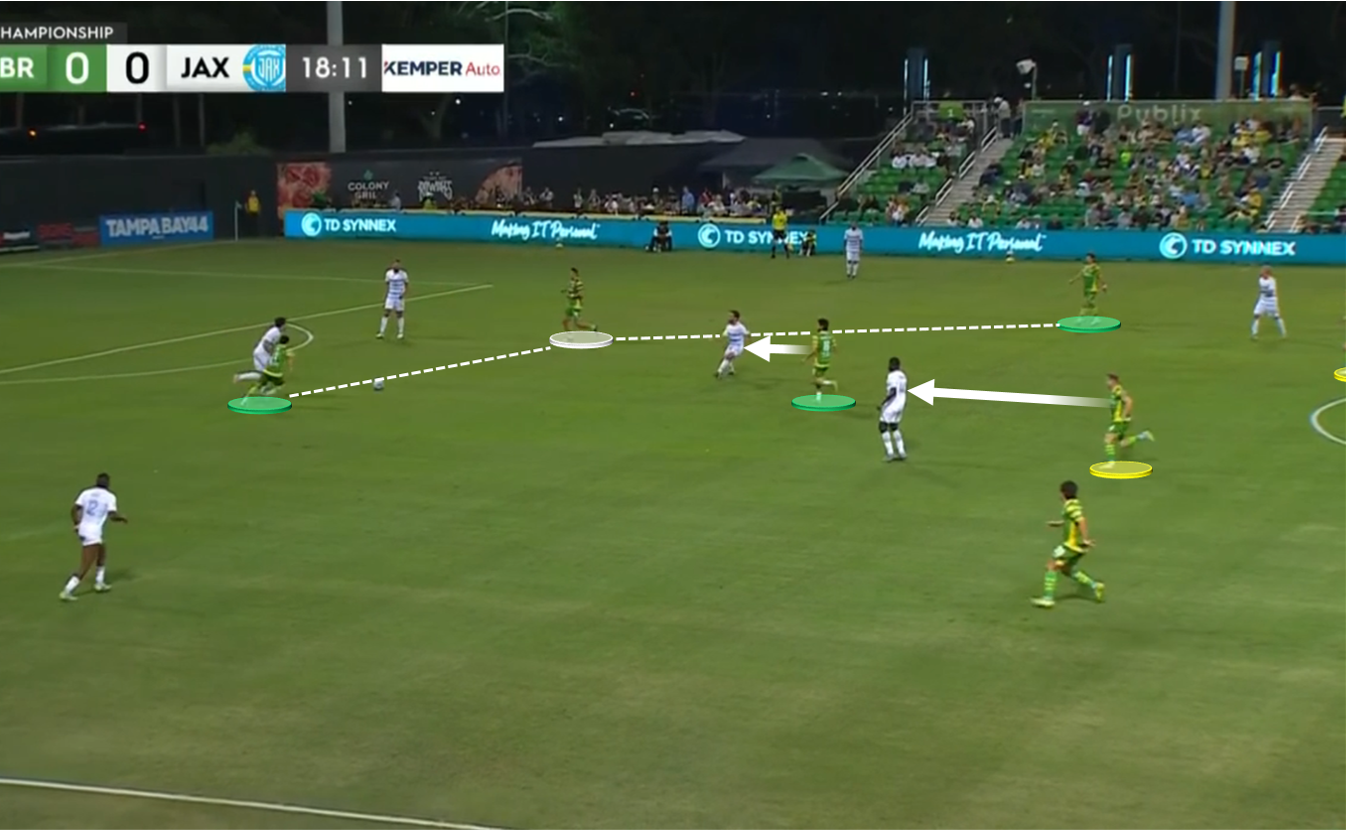
Tampa Bay’s 4-2-3-1 pushed its wingers high against Jacksonville’s back three. Gino Vivi, Karsen Henderlong and Evan Conway led the press, while midfield support helped turn pressure into possession wins. The shape gave the Rowdies a way to challenge Jacksonville near the back line while keeping support close enough to compete for the ball after the press forced a hurried pass. Marco Micaletto tracked the opposing side’s deepest No. 8; Lewis Hilton and Laurence Wyke took turns stepping forward to pick up runners. When the Rowdies forced Jacksonville into a mistake, they had room to break quickly.
Jacksonville’s long balls tested the defense, but Leland Archer chased them down and Wyke covered space behind the line, particularly when young right back Alex Rodriguez advanced. That cover let Tampa Bay commit numbers to attack. It also points to the tradeoff in pushing a fullback forward: the attack gains width and an extra option, while the defenders behind the move have to manage open space. Henderlong’s 29th-minute goal capped one such move and put the Rowdies on course for the clean-sheet win.
A finale shaped by fine margins
The wider playoff picture made Tampa Bay’s controlled finish stand out. The West’s top seed changed hands, the East’s last postseason place was settled, and Phoenix’s late claim to eighth came in a short window around midnight. Such swings show how a final slate can turn standings into a live contest, with results elsewhere carrying as much weight as the match in front of a team. For clubs near the cutoff, there’s little comfort in a strong performance if a rival’s result changes the equation.
That said, seeding and qualification are only part of what the final day revealed. The top four in each conference secured home-field advantage for the opening round, giving their regular-season position a direct consequence. Teams entering from lower spots face a different path, while those with home field have earned the chance to begin on familiar ground. The standings establish that edge; they don’t settle what happens once the postseason starts.
What Tampa Bay carries into the postseason
With the playoff field set, Tampa Bay carries a settled style into the postseason. The final day showed how quickly the bracket could change; the Rowdies’ closing performance showed what a team can preserve amid the churn. Nine lineup changes and a win are encouraging evidence of depth, though one match can’t establish how that depth will hold up under playoff pressure. The more persuasive point is that the team’s pressing, midfield support and defensive cover remained connected across the lineup.
Here’s the thing: consistency doesn’t guarantee a long postseason run, but it gives a team a clear reference point when matches become tense. If you’re working in this space, watch whether Tampa Bay can keep its wingers high without leaving the defense exposed, and whether its midfield can keep turning pressure into possession. Those details made the finale work. The test ahead is whether the Rowdies can reproduce them when the margin for error narrows.
A clean sheet to close the regular season. And a recognizable plan carried into a new phase.

Discussion
Sign in to join the discussion.