Sturm Graz goalkeeper Daniil Khudyakov underwent surgery after a collision with Jacob Italiano in a 6-1 derby win over Grazer AK.

A derby win eclipsed by a serious injury
Sturm Graz’s 6-1 derby win over Grazer AK should have been remembered as a decisive result. Instead, the scoreline was pushed into the background by a serious injury to Sturm goalkeeper Daniil Khudyakov and the distress shown by Australia international Jacob Italiano, whose challenge caused the collision. A local rivalry can give a match extra edge, but the incident left little room to dwell on the result.
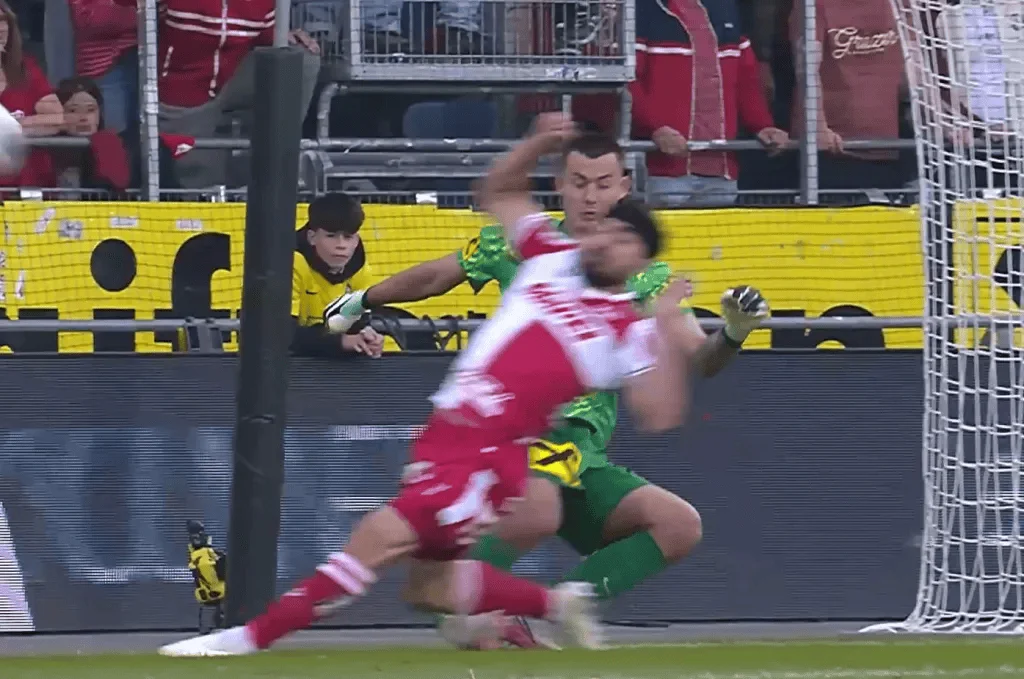
The collision happened in the 21st minute, with the match still in its early stages. Italiano chased a backpass as Khudyakov moved to kick the ball, and the pair made contact when Italiano caught the goalkeeper’s trailing leg. The account gives no indication that Italiano intended to injure him; the consequences, however, were severe.
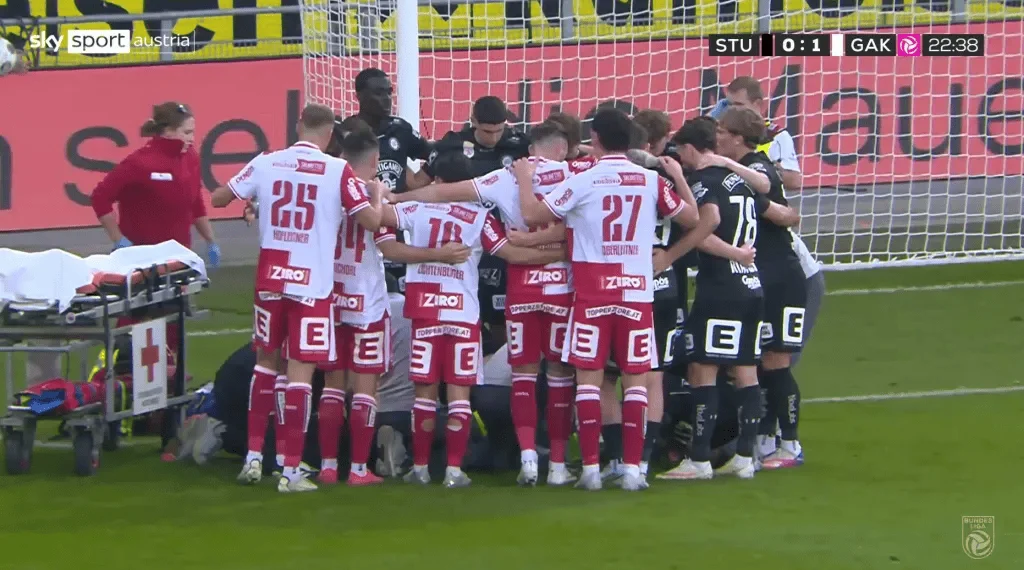
Players from both teams shielded Khudyakov while he received attention on the pitch. He was then taken off on a stretcher. The players’ response is a reminder of how quickly the competitive rhythm of a match can give way to concern when an injury appears serious.
Khudyakov undergoes surgery
Grazer head coach Fabio Ingolitsch said Khudyakov was having surgery after suffering what he described as “a clean lower-leg fracture.” He also said first responders had worked on the pitch to protect the blood vessels, and called the injury “very, very serious.” Those details make clear why the incident prompted such concern, though they don’t establish anything further about the goalkeeper’s recovery or when he might return.
Injuries involving a goalkeeper can be especially difficult to watch because the player is often committed to completing a kick as an opponent closes in. That’s the situation described here: Khudyakov was playing the backpass while Italiano was pursuing it. A brief collision in that moment was enough to end the goalkeeper’s involvement in the match and lead to surgery.
For the teams, the immediate priority was plainly Khudyakov’s care. The players formed a screen around him, and first responders treated him on the pitch before he left on a stretcher. In an incident like this, the visible response matters: it gives the injured player space and signals that the contest has stopped being the main concern.
Der folgenschwere Zweikampf mit Daniil Khudyakov hat Jacob Italiano sichtlich zugesetzt. Nach dem Spiel wünscht der GAK-Profi dem schwer verletzten Sturm-Schlussmann eine schnelle Genesung!
— Sky Sport Austria (@SkySportAustria) October 19, 2026Zum Interview
https://t.co/QgXPem90Rv #SkyBuliAT #STUGAK #Italiano #Khudyakov https://t.co/yhXYZc7zCB
Italiano told Sky Sport Austria that he hadn’t intended to hurt Khudyakov and wished him well in his recovery. He said, “This is more important than football,” and hoped to contact the goalkeeper in hospital and send him something. His words describe the personal weight of the collision without changing the fact that Khudyakov is the one facing the injury and its recovery.
“I really hope he comes back stronger,” Italiano said.
That show of concern is understandable, but it also points to an uncomfortable feature of football: a player can cause serious harm in a challenge without meaning to. The intent and the outcome aren’t the same thing. This is more significant than it looks, because how players and officials respond to the aftermath can shape the discussion long after the final whistle.
Jauk questions refereeing
Sturm Graz president Christian Jauk criticized the decision not to penalize Italiano. He said the match had been aggressive from the outset and argued that the referee had failed to manage it. He also called for better quality in Austrian football to help prevent similar incidents. The comments broaden the issue from one collision to how officials handle the tone of a match before a serious injury occurs.
The available account doesn’t specify which earlier moments Jauk believed the referee should have managed differently, or what decision he thought should have followed the challenge. That limits how far his criticism can be assessed from these details alone. Still, his argument raises a familiar question in football: whether referees can calm an increasingly physical match through consistent decisions, and whether players understand where the line is being drawn.
There’s a distinction between reviewing one challenge and judging the wider control of a match. Jauk’s criticism concerns both: Italiano wasn’t penalized for the collision, and, in Jauk’s view, the referee had allowed an aggressive atmosphere to develop. A single decision can be judged on its own facts; the broader claim depends on the pattern of play he says preceded it.
That said, the injury shouldn’t be treated as proof of a particular refereeing failure. The reported facts establish the collision, the fracture and Jauk’s criticism; they don’t settle whether another call would have prevented the injury. The gap between a serious outcome and what can be inferred about its cause is one that deserves care.
The result in context
The derby ended 6-1 to Sturm Graz, but the result sits alongside a very different story about the cost of the afternoon. After nine rounds, Sturm were fourth, seven points behind league leaders Rapid Vienna, where Marco Tilio plays. Grazer AK were eighth with nine points. Those standings give the match a league context, but they don’t diminish the injury’s immediate importance.
For supporters, the score would normally invite discussion of the teams’ performance and what the points mean in the table. Here, Khudyakov’s surgery and the players’ reaction have taken precedence. The contrast is stark: a large winning margin on one side, a serious injury on the other.
What the incident leaves behind
If you’re working in football, the episode is a reminder that match management is judged in more than the final score. It’s also judged in moments when the pace, physicality and emotion of a game collide. Jauk has made a direct criticism of the referee, while Italiano has expressed regret and concern for Khudyakov. Neither statement answers every question about the challenge, but together they show how the incident has affected both clubs.
Here’s the thing: the derby’s result is clear, while the longer-term effects of the injury aren’t. Khudyakov was having surgery, and Italiano said he hoped to reach out to him in hospital. What comes next for the goalkeeper will depend on his recovery, details the account doesn’t provide.
A fractured lower leg, surgery and concern about blood vessels. The details are sobering.
And yet, the response also offers a small measure of perspective. Players from both sides shielded Khudyakov, and the opponent involved publicly wished him well. That doesn’t resolve Jauk’s questions about officiating or make the injury less serious. It does show that, when the match stopped, the immediate concern was the injured player rather than the rivalry.
Discussion
Sign in to join the discussion.